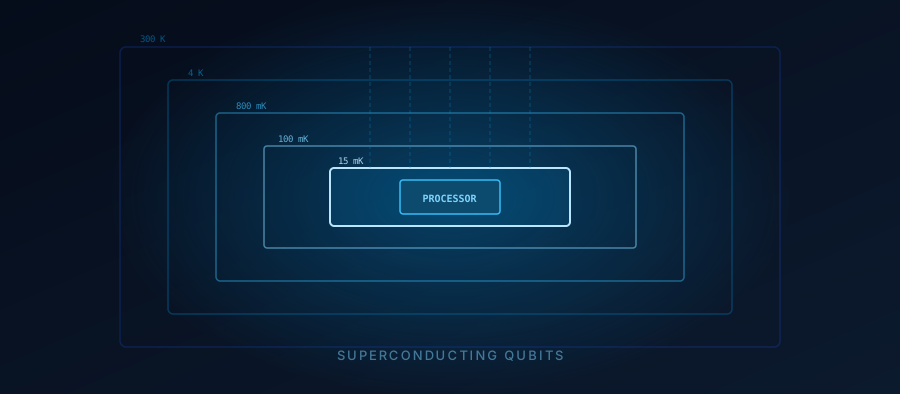
Every time IBM or Google announces a new quantum processor, the headline focuses on qubit count. What the press release does not convey is the engineering required to make those qubits work: a machine the size of a chandelier, operating at fifteen millikelvin — a temperature 150 times colder than deep space and 20,000 times colder than your living room — threaded with hundreds of hand-soldered coaxial cables, shielded from every stray electromagnetic field and ambient vibration, all to preserve a quantum state in a circuit smaller than a human fingernail for a few hundred microseconds.
Superconducting quantum computers are the dominant platform in the industry today. Understanding why requires going inside the hardware — down to the Josephson junction.
The Josephson Junction: An Artificial Atom
At the heart of every superconducting qubit is a Josephson junction: two pieces of superconducting metal separated by a barrier roughly two nanometres thick — a few dozen atoms of aluminium oxide. In ordinary metals, electrons scatter off atomic vibrations and impurities, dissipating energy as heat. Below a critical temperature (1.2 K for aluminium), electrons pair up into Cooper pairs and flow without resistance through a different quantum mechanical mechanism.
The effect at a Josephson junction is stranger still. Cooper pairs can tunnel through the insulating barrier — quantum mechanically crossing a gap they have no classical energy to traverse. This tunnelling creates a supercurrent whose magnitude depends on the quantum phase difference across the junction according to a nonlinear relationship described by the Josephson equations.
That nonlinearity is the critical ingredient. A simple LC circuit — an inductor and capacitor in a resonant loop — has uniformly spaced energy levels: the energy required to go from level 0 to 1 is identical to going from 1 to 2, 2 to 3, and so on. This uniformity makes it impossible to isolate a two-level qubit: microwave pulses addressing the |0⟩→|1⟩ transition would simultaneously drive |1⟩→|2⟩. The Josephson junction acts as a nonlinear inductor that distorts the energy ladder, making each rung a different height. Only the lowest two levels are addressed — |0⟩ and |1⟩ — and the qubit is defined.
The Transmon: Engineering Stability
The most widely deployed superconducting qubit design is the transmon, developed at Yale in 2007. Its key insight: shunting the Josephson junction with a large capacitor reduces the qubit’s sensitivity to charge fluctuations — the dominant decoherence source in earlier designs — at the cost of slightly reducing the anharmonicity (the unevenness of energy spacing). The trade-off is overwhelmingly worthwhile. Transmon coherence times have improved from nanoseconds in early Cooper-pair-box qubits to hundreds of microseconds today — a factor of over 100,000 over two decades.
A transmon resonates at 4–8 GHz and executes single-qubit gates in 10–50 nanoseconds. Two-qubit gates run in 100–400 nanoseconds. With T1 and T2 coherence times around 200–500 microseconds on current chips, there is time for thousands of gate operations before the quantum state degrades irreversibly. IBM’s Eagle, Osprey, Condor, and Heron processors are all transmon-based. So is Google’s Sycamore.
The Dilution Refrigerator: 20,000 Times Colder Than Room Temperature
Transmon qubits must be operated at 10–20 millikelvin. The reason is quantitative: at 15 mK, thermal energy kT ≈ 1.3 × 10⁻²⁵ joules. The qubit transition energy at 5 GHz is roughly 3.3 × 10⁻²⁴ joules — about 25 times larger. This means thermal fluctuations cannot spontaneously excite the qubit from |0⟩ to |1⟩ with any significant probability. At 300 K, they absolutely would.
The machine achieving this is a dilution refrigerator, and its operating principle is quantum mechanical. At temperatures below 870 mK, a mixture of helium-3 and helium-4 isotopes spontaneously separates into two phases. Pumping the helium-3-rich phase away forces ³He atoms to cross the phase boundary, absorbing latent heat with extraordinary efficiency. The “mixing chamber” at the bottom of this process reaches base temperatures below 10 mK.
Surrounding the processor are concentric radiation shields at each thermal stage. Stray infrared photons from room-temperature components carry enough energy to excite the qubit; even the thermal radiation of a 4 K shield must be blocked. Every electrical signal line entering the fridge is thermally anchored at each stage through attenuators and filters. A thousand-qubit processor requires hundreds of such lines — each a potential heat leak.
Microwave Control and the Wiring Problem
Qubit operations arrive as microwave pulses — precisely shaped envelopes at 4–8 GHz, generated by room-temperature electronics, attenuated at each thermal stage, and finally delivered to the chip. A single-qubit gate is a nanosecond-scale Gaussian-shaped pulse. A two-qubit gate — the cross-resonance gate used by IBM, or the controlled-Z gate used by Google — couples two qubits through a shared resonator or direct capacitive interaction.
Reading out a qubit’s state requires a separate microwave tone, a coupled readout resonator per qubit, and a chain of amplifiers working upward from the mixing chamber. The first amplifier — a Josephson parametric amplifier — must operate at millikelvin and add almost no noise. Each qubit thus requires multiple dedicated signal lines threading the entire thermal stack.
Scaling this to a million qubits — the number most estimates require for fault-tolerant factoring of RSA-2048 — is the defining engineering challenge of superconducting quantum computing. IBM and Google are pursuing multiplexed control lines, cryogenic classical electronics, and modular multi-chip architectures. None has yet demonstrated the techniques at scale. The physics is understood. The engineering is not solved.
The Path Forward
Superconducting quantum processors are extraordinary machines. Their qubit counts, gate fidelities, and cycle times have improved roughly exponentially for fifteen years. The engineering required to go further — cryogenic interconnects, on-chip control circuits, multi-chip entanglement — is largely a matter of systems integration rather than fundamental physics.
Whether superconducting systems reach the qubit counts needed for fault-tolerant computation before competing platforms — trapped ions, neutral atoms, photonics — depends on progress in three areas: coherence at scale, wiring density at millikelvin, and error correction overhead. The next five years will determine which constraints are surmountable and which are not.
Sources & Further Reading
- Charge-Insensitive Qubit Design Derived from the Cooper Pair Box (the transmon). Physical Review A 76, 042319; arXiv:cond-mat/0703002 (2007)
- Superconducting Circuits for Quantum Information: An Outlook. Science 339, 1169 (2013)
- A Quantum Engineer's Guide to Superconducting Qubits. Applied Physics Reviews 6, 021318; arXiv:1904.06560 (2019)
Discussion