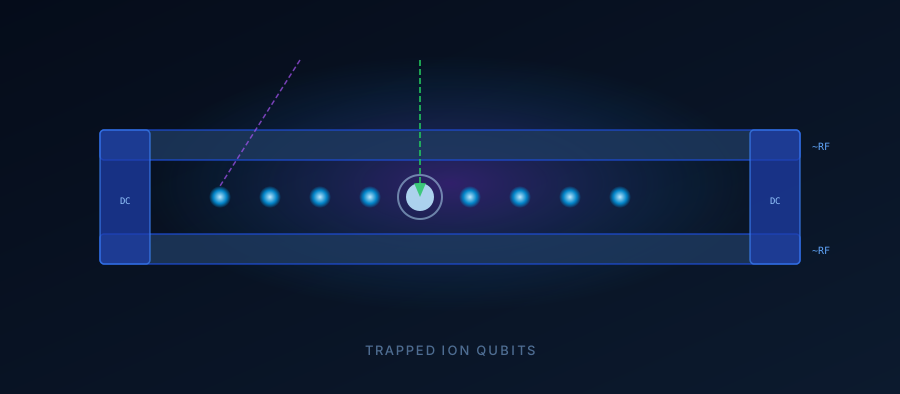
Every element on the periodic table has electrons bound to a nucleus. Remove one of those electrons and you have an ion — a charged atom that responds predictably to electric and magnetic fields. Confine that ion in a vacuum, cool it with laser light until its motion reaches the quantum ground state, and you have a qubit with coherence times measured not in microseconds but in minutes.
Trapped ion quantum computers are the principal competitor to superconducting systems. They are demonstrably more precise at the individual qubit level, naturally provide all-to-all connectivity between qubits, and operate at room temperature. Their limitation is not fidelity — it is scale. Understanding both the physics and the constraint requires following a single ytterbium ion from the moment it enters a trap to the moment its state is read out.
The Paul Trap: Holding an Atom With Electric Fields
A static electric field cannot trap a charged particle in all three dimensions — Earnshaw’s theorem forbids it. Any static configuration that pushes the ion toward the centre in two directions must pull it outward in the third. The Paul trap, developed by Wolfgang Paul in the 1950s (earning him the 1989 Nobel Prize), solves this with a time-varying field.
A radio-frequency voltage applied to the trap electrodes creates a rapidly oscillating quadrupole electric field. During each half-cycle, the field pushes the ion inward in two directions and outward in one. In the next half-cycle, the directions reverse. If the voltage oscillates fast enough, the ion’s inertia prevents it from following the outward kicks — it integrates the time-averaged force, which points toward the centre in all three dimensions. The result is a stable, controllable confining potential.
Linear Paul traps extend this principle along one axis. A chain of ions aligns along the trap’s symmetry axis, held in place by the balance between the trap’s axial confinement and the mutual electrostatic repulsion between like-charged ions. A twenty-ion chain might extend 0.2 mm — each ion separated from its neighbours by roughly ten micrometres. The spacing is precise enough that tightly focused laser beams can address individual ions independently.
The environment inside a Paul trap is extreme in its quietness. Background pressure is maintained at around 10⁻¹¹ torr — comparable to the vacuum on the surface of the Moon. At that pressure, a trapped ytterbium ion might remain in the trap for months before a collision with a residual gas molecule ejects it. The trap itself operates at room temperature; no cryogenics are required.
Laser Cooling: From Room Temperature to the Ground State
Ions arrive in the trap with room-temperature velocities. For quantum computation they must be cooled to the quantum mechanical ground state of their motion — a process driven entirely by laser light.
Doppler cooling is the first stage. A laser tuned slightly below a strong atomic transition is directed at the ion. An ion moving toward the laser sees the light blue-shifted closer to resonance; it absorbs a photon and recoils backward. The photon is then re-emitted in a random direction. After millions of absorption-emission cycles, the average recoil removes momentum while the emission averages to zero. Doppler cooling takes ions from ~300 K to the millikelvin regime in milliseconds.
Resolved sideband cooling cools further, to the motional ground state. When the ion’s motion is slow enough that the oscillation frequency in the trap is resolved from the natural linewidth of the atomic transition, laser pulses can selectively remove individual quanta of motional energy — phonons. Driving the red motional sideband excites the ion’s internal state while simultaneously removing one phonon from the motion. After optical pumping resets the internal state, the ion has one fewer phonon and the process repeats. After many cycles, the ion sits in the ground state of its motion with high probability.
Qubit States: Encoded in Atomic Structure
The qubit is encoded in two internal electronic states of the ion. Two common choices exist, each with distinct properties.
Optical qubits use the ground state and a long-lived metastable excited state separated by an optical frequency transition. Gate operations use narrow-linewidth lasers. Coherence is limited by the excited state lifetime — seconds in well-chosen ions — but optical transitions are more sensitive to magnetic field noise and laser frequency drift.
Hyperfine qubits, used by IonQ (ytterbium-171) and Quantinuum (barium-137), encode the qubit in two hyperfine ground states — energy levels split by the interaction between the nuclear and electron spins, differing in frequency by a few gigahertz. These states are magnetically nearly identical, making the transition frequency nearly immune to magnetic field fluctuations. Coherence times exceeding ten minutes have been demonstrated, compared to hundreds of microseconds in superconducting transmons. This difference — roughly five orders of magnitude — has profound consequences for how much error correction overhead a trapped ion system requires compared to a superconducting one.
Single-qubit gates are implemented with laser pulses or microwave pulses resonant with the qubit transition, achieving fidelities above 99.9% routinely.
The Mølmer-Sørensen Gate: Entangling Through Shared Motion
The two-qubit gate in a trapped ion processor is one of the most elegant operations in experimental quantum physics. Ions in a linear chain cannot touch — they are separated by micrometres and held in place by electrostatic repulsion. Yet they interact, through a shared quantum mechanical bus: the collective vibrational modes of the chain.
When the entire chain vibrates, all ions participate. These collective motional modes are quantised — the chain can hold zero, one, two, or more phonons of vibration energy, each a quantum of shared motion. The Mølmer-Sørensen gate exploits this coupling: laser beams tuned near the motional sidebands of two target ions simultaneously drive both ions, entangling their internal qubit states through the shared phonon field. The gate begins and ends with the motional mode in its original state — it uses the phonons as an intermediary and leaves no trace in them.
The result is a two-qubit entangling gate between any pair of ions in the chain — not just neighbours. Unlike superconducting processors, where entanglement is constrained by physical adjacency and bus connectivity, trapped ion systems provide all-to-all connectivity by default. Any ion can be entangled with any other ion in the trap through the motional modes. This dramatically reduces the circuit depth needed for many quantum algorithms and simplifies the overhead of error correction.
Demonstrated two-qubit gate fidelities in trapped ion systems have reached 99.9% at IonQ and Quantinuum — the highest values achieved in any qubit platform.
The Scaling Problem
Trapped ion systems face a fundamental constraint: as more ions are added to a linear chain, the number of collective motional modes grows, their frequencies crowd together, and addressing individual modes without crosstalk becomes increasingly difficult. In practice, linear chains operate well up to 30–50 ions; beyond that, gate performance degrades.
Two strategies are being pursued to scale beyond this limit.
Photonic interconnects link multiple small traps using optical fibres. An ion in one trap emits a photon entangled with its internal state; that photon travels to a second trap and entangles with an ion there. The process is slow — photon emission is probabilistic and link efficiency is low — but it enables entanglement between traps separated by metres or kilometres. Quantinuum’s roadmap is built on this principle: a network of small, high-fidelity ion traps connected photonically.
Ion shuttling in 2D trap arrays takes a different approach. Rather than a single chain, a planar trap with multiple zones allows ions to be moved between gate zones and memory zones using time-varying electrode voltages. IonQ’s Forte processor and several academic groups at MIT Lincoln Laboratory and ETH Zurich are developing this architecture. Ions are shuttled individually, two are brought together for a gate, and the result is stored in a separate memory zone. The trap acts more like a quantum processor’s register file than a fixed chain.
Why the Competition Matters
The contest between superconducting and trapped ion quantum computers is not winner-take-all. The two platforms have complementary strengths: superconducting systems offer speed and demonstrated qubit counts above a thousand; trapped ion systems offer precision, coherence, and connectivity. The error correction requirements differ as a consequence. A trapped ion system with minutes of coherence and 99.9% two-qubit fidelity needs fewer physical qubits per logical qubit than a superconducting system with microseconds of coherence and 99.5% fidelity.
Which platform reaches fault-tolerant, error-corrected computation first — and at what cost — remains genuinely uncertain. What is clear is that the physics of trapped ions is not the limiting factor. The engineering of how to hold, cool, address, and connect thousands of individual atoms without losing their extraordinary precision is.
Sources & Further Reading
- Quantum Computations with Cold Trapped Ions. Physical Review Letters 74, 4091 (1995)
- Quantum Computation with Ions in Thermal Motion. Physical Review Letters 82, 1971; arXiv:quant-ph/9810039 (1999)
- Trapped-Ion Quantum Computing: Progress and Challenges. Applied Physics Reviews 6, 021314; arXiv:1904.04178 (2019)
- Demonstration of the Trapped-Ion Quantum CCD Computer Architecture. Nature 592, 209; arXiv:2003.01293 (2021)
Discussion