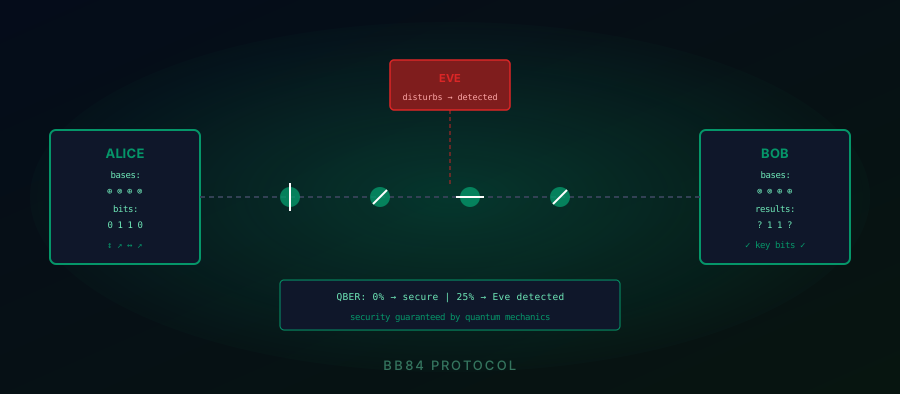
Section
Quantum Cryptography
Where BB84 detects eavesdroppers by watching for measurement disturbances on individual photons, E91 — proposed by Artur Ekert in 1991 — detects them by testing whether quantum correlations between entangled photon pairs violate a Bell inequality. If they do, no eavesdropper could have intervened. Here is the physics, the mathematics of the CHSH test, and why E91's entanglement-based approach leads directly to device-independent quantum cryptography.
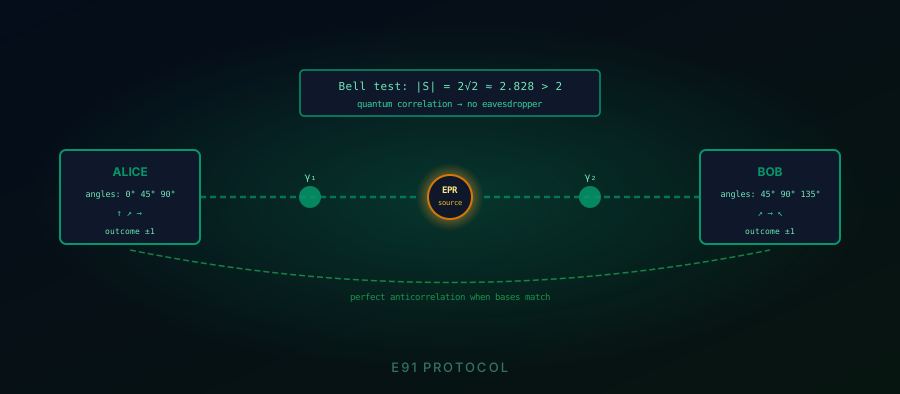
- Post-Quantum Cryptography: The Algorithms Replacing RSA Before the Quantum Computer Arrives
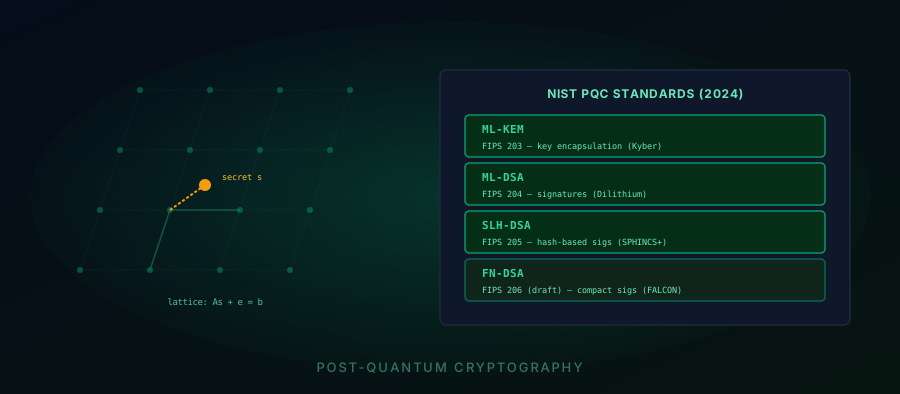
Every TLS connection, every signed certificate, every encrypted email uses cryptography that Shor's algorithm can break. NIST finalised four post-quantum cryptographic standards in 2024 — ML-KEM, ML-DSA, SLH-DSA, and FN-DSA — based on mathematical problems that quantum computers are not known to solve efficiently. Here is the threat model, the mathematics, the size trade-offs, and why migration is already urgent even though the quantum computer does not exist yet.
- BB84: The Protocol That Made Eavesdropping a Physics Problem
The BB84 protocol, proposed in 1984, showed for the first time that physical law — not computational hardness — could guarantee communication security. Here is exactly how it works, why an eavesdropper cannot hide, and what the real-world limitations are.