The most important thing to understand about Grover’s algorithm is the thing most popular accounts get wrong: it does not break symmetric cryptography. It weakens it — precisely, predictably, and in a way that can be completely neutralised by doubling key lengths. This is fundamentally different from what Shor’s algorithm does to RSA, which it renders unconditionally broken at any key size.
This distinction matters enormously. Organisations that treat all quantum cryptographic risk as equivalent — migrating away from AES-128 with the same urgency as migrating away from RSA — are either misunderstanding the threat model or hedging excessively. Organisations that dismiss Grover’s algorithm as minor are potentially vulnerable to key-space reductions that put AES-128 within reach of a quantum adversary. Getting this right requires understanding the algorithm at a level beyond headlines.
Grover’s algorithm solves the unstructured search problem: given a black-box function f that returns 1 for exactly one item in a database of N items and 0 for all others, find the marked item. Classically, there is no better strategy than checking items one by one — evaluations in the worst case, on average. Grover’s algorithm finds the marked item in quantum evaluations. This quadratic speedup is provably optimal: no quantum algorithm can do better for unstructured search.
Key Concepts in This Article
Phase Oracle
The quantum subroutine that marks the target item by flipping its amplitude from positive to negative: |x⟩ → (−1)^f(x)|x⟩. It does not reveal which item is marked; it only flips a sign.
Diffusion Operator
Also called "inversion about the mean." Reflects all amplitudes through their average value, amplifying the marked item's amplitude and suppressing the rest. Defined as D = 2|ψ⟩⟨ψ| − I.
Grover Iteration
One application of the oracle followed by the diffusion operator. Geometrically, this rotates the quantum state by 2θ ≈ 2/√N toward the target in a 2D subspace. After π√N/4 iterations, the target is found with near-certainty.
Amplitude Amplification
The generalisation of Grover's algorithm. If any quantum procedure finds a solution with probability p, amplitude amplification can boost success to near-certainty in O(1/√p) uses of that procedure.
The Oracle: Marking Without Revealing
The foundation of Grover’s algorithm is the phase oracle — a quantum circuit that implements the function f without revealing which input it marks.
The oracle is a unitary operator O that acts as:
For the unmarked items (f(x) = 0), nothing happens. For the marked item x* (f(x*) = 1), the amplitude is negated: the state |x*⟩ picks up a phase of −1. Since amplitudes can be negative, this is a physically meaningful transformation even though it is invisible to classical intuition.
The oracle does not reveal which item is marked. The phase flip is hidden inside the quantum amplitude — it cannot be directly read out by measurement without destroying the superposition. It manifests only through interference in subsequent steps.
In practice, the oracle encodes a specific computational problem. For database search, it checks a condition (is this the matching record?). For satisfiability, it checks whether a given variable assignment satisfies a Boolean formula. For key search in cryptography, it evaluates whether a candidate key decrypts a known plaintext to a known ciphertext. The oracle is a reversible quantum circuit implementing that check, and its cost determines the practical runtime of the algorithm.
Amplitude: The Mechanism of Speedup
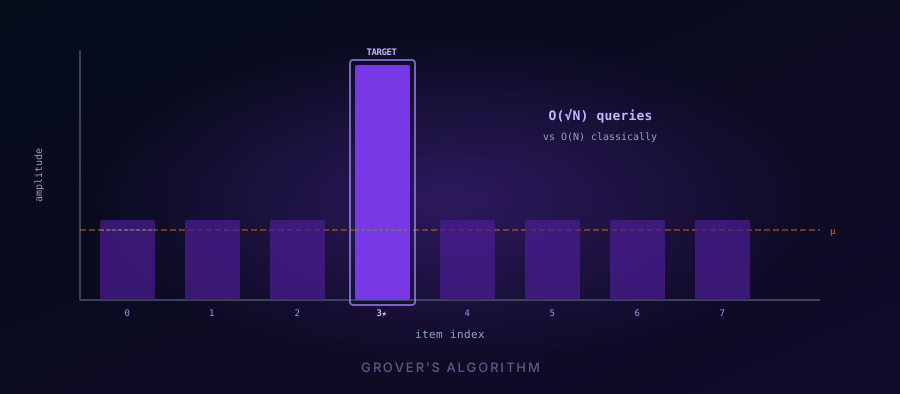
To understand Grover’s algorithm, you must think in amplitudes rather than probabilities. A quantum state over N items is a vector of N complex numbers — one amplitude per item — whose squared magnitudes sum to 1. Measurement yields item x with probability equal to the square of its amplitude.
Starting in the uniform superposition , every item has amplitude and probability . The target item is as likely to be found as any other — measuring now gives the right answer with probability . The algorithm’s task is to concentrate probability on the target without knowing in advance which item it is.
The Diffusion Operator: Inversion About the Mean
The core operation after the oracle is the diffusion operator (also called Grover diffusion or inversion about the mean):
where is the uniform superposition. This operator maps every amplitude to , where is the mean of all amplitudes. The transformation reflects each amplitude through the mean: amplitudes above the mean are pushed below it, and amplitudes below the mean are pushed above it.
After the oracle flips the target’s amplitude to (negative, while all others remain ), the mean drops below its original value. Inverting about this lower mean amplifies the target amplitude (which was far below the mean and is now reflected to far above it) and suppresses all other amplitudes (which were slightly above the mean and are now reflected to slightly below it).
The circuit for the diffusion operator, acting on the n-qubit register:
- Apply H⊗ⁿ (transform to the standard basis)
- Apply a phase flip to |00…0⟩ (implemented by a multi-controlled-Z gate)
- Apply H⊗ⁿ (return to the Hadamard basis)
This is O(n) elementary gates for the Hadamards, plus one multi-controlled gate — efficient and local.
The Geometric Picture: A Rotation in 2D
The most illuminating way to understand Grover’s algorithm is geometric. The entire computation takes place in a 2D subspace spanned by two orthogonal vectors:
- |target⟩ — the computational basis state corresponding to the answer
- — the uniform superposition over all non-target items (normalised)
Every quantum state in Grover’s algorithm lives in this plane.
The initial state makes a small angle with the axis, where . This angle is tiny — for (an AES-128 key space), radians.
Each Grover iteration performs two reflections:
- The oracle reflects the state about the |other⟩ axis (negating the target component)
- The diffusion operator reflects about the initial state |ψ⟩
The composition of two reflections is a rotation. The angle of rotation is . After iterations, the state has rotated to angle from . When this angle reaches , the state is perfectly aligned with and measurement yields the target with certainty.
The optimal number of iterations is:
This is where comes from. For , — far from classical impossibility, but still an astronomical number of oracle calls.
Overrotation: If you run more than k* iterations, the state rotates past |target⟩ and probability begins to decrease. Running exactly k* is necessary; running too many is as bad as running too few. This is a crucial operational constraint with no classical analogue.
The Circuit
Why √N and Not Faster: The Optimality Proof
Grover’s quadratic speedup is not merely the best known algorithm — it is provably the best possible for any quantum algorithm. Bennett, Bernstein, Brassard, and Vazirani proved in 1997 that any quantum algorithm requires at least oracle queries to find a marked item in an -item unstructured search with bounded error probability.
The proof uses a polynomial method argument: the probability of finding the marked item after oracle queries is a polynomial of degree in the input (which encodes which item is marked). For this probability to be large, the polynomial must distinguish the marked case from the unmarked case, which requires its degree to be at least . Therefore .
This is a fundamental result: not just an engineering constraint, but a mathematical lower bound. No matter how clever the algorithm, no matter how exotic the quantum hardware, unstructured search cannot be solved faster than √N queries. The implication for cryptography is significant: the quadratic speedup is the ceiling, not a floor. No future quantum algorithm will provide an exponential speedup on unstructured key search.
What Grover’s Can and Cannot Do
What Grover’s algorithm helps with:
- Unstructured database search: the original problem — O(√N) queries to find one item in N.
- Brute-force key search in symmetric cryptography: searching over a 2^k key space in O(2^(k/2)) quantum queries. This halves the bit security of any symmetric key.
- Collision finding (via BHT): the Brassard-Høyer-Tapp algorithm uses amplitude amplification to find hash collisions in O(2^(n/3)) time instead of the classical O(2^(n/2)) birthday attack.
- NP-hard problems: any problem with an efficiently checkable solution (SAT, graph colouring, travelling salesman) gets a quadratic speedup via Grover on the brute-force search. This does not solve NP in polynomial time — it solves NP in the square root of the brute-force time.
What Grover’s algorithm does not help with:
- RSA and ECC: these require Shor’s algorithm (order-finding), not search. Grover is irrelevant to factoring.
- Lattice problems: the best known quantum attack on lattice-based cryptography does not involve Grover.
- Structured problems with classical polynomial algorithms: if a problem is already solvable in polynomial time classically, Grover’s quadratic speedup does not help (squaring a polynomial is still polynomial).
- Breaking post-quantum cryptography: NIST’s finalised PQC algorithms (ML-KEM, ML-DSA, SLH-DSA) are designed to resist Grover’s attack — their security parameters account for the quadratic speedup.
The Cryptographic Consequence: Symmetric Key Security
The practical implication for symmetric cryptography is simple: double your key size. An n-bit symmetric key provides n/2-bit quantum security. Therefore:
- AES-128 offers only 64-bit quantum security — insufficient for data that must remain secret for more than a decade. NIST and CISA recommend migrating to AES-256 for quantum resistance.
- AES-256 offers 128-bit quantum security — universally considered secure against any foreseeable quantum attack.
- SHA-256 is safe for preimage resistance (128-bit quantum security) but has somewhat reduced collision resistance via the BHT algorithm. SHA-384 is recommended for applications sensitive to collision attacks.
The migration from AES-128 to AES-256 is low-risk and largely backward-compatible. Unlike the migration away from RSA — which requires completely replacing the algorithm — moving to AES-256 requires only a configuration change in most systems. This is why symmetric cryptography is considered less urgently threatened by quantum computing than asymmetric cryptography, despite the existence of Grover’s algorithm.
Amplitude Amplification: The General Framework
Grover’s algorithm is a special case of a more general quantum technique called amplitude amplification. Given any quantum algorithm A that finds a solution with probability p (perhaps a small probability from a heuristic or randomised method), amplitude amplification can boost success probability to near-certainty using only O(1/√p) applications of A.
The mechanism is identical to Grover: A plays the role of the “oracle” that marks good states, and the diffusion is applied in the space defined by A’s action. Where Grover starts from scratch (p = 1/N), amplitude amplification can start from any initial success probability and boost it, making it a general-purpose acceleration tool for any quantum algorithm with probabilistic output.
Amplitude amplification appears in quantum walk algorithms, quantum Monte Carlo methods, and quantum optimisation algorithms. It is one of the most broadly applicable subroutines in the quantum algorithm toolkit, and understanding Grover’s algorithm is the foundation for understanding all of them.
The Honest Assessment
Grover’s algorithm is important but often over-hyped in both directions: some accounts treat it as an existential threat to all cryptography (it isn’t), while others dismiss it as too slow to matter (the 64-bit security of AES-128 is a real concern for long-term data sensitivity).
The correct framing: Grover’s algorithm is a precise, optimal, and provably useful quantum speedup that has a well-understood impact on symmetric cryptography and a broader role in quantum algorithm design via amplitude amplification. It does not render any algorithm completely broken — it shifts the security level by exactly a factor of two in the exponent. That shift is manageable with larger keys, and the tools to manage it (AES-256, SHA-384) already exist.
The enduring significance of Grover’s algorithm is not the specific cryptographic threat it represents, but what it reveals about the nature of quantum advantage: quantum computers can exploit amplitude interference to concentrate probability on correct answers in a completely general, black-box setting, without any structural knowledge of the problem. That capability — the ability to amplify good answers from bad ones using only the ability to check — is the most primitive form of quantum advantage, and it applies everywhere a classical algorithm would exhaustively search.
Sources & Further Reading
- A Fast Quantum Mechanical Algorithm for Database Search. Proc. 28th Annual ACM Symposium on Theory of Computing (STOC); arXiv:quant-ph/9605043 (1996)
- Strengths and Weaknesses of Quantum Computing. SIAM Journal on Computing 26(5); arXiv:quant-ph/9701001 (1997)
- Tight Bounds on Quantum Searching. Fortschritte der Physik; arXiv:quant-ph/9605034 (1998)
- Advanced Encryption Standard (AES) — FIPS 197. Federal Information Processing Standards Publication 197 (2001)
Discussion