Tag
#post-quantum cryptography
5 articles
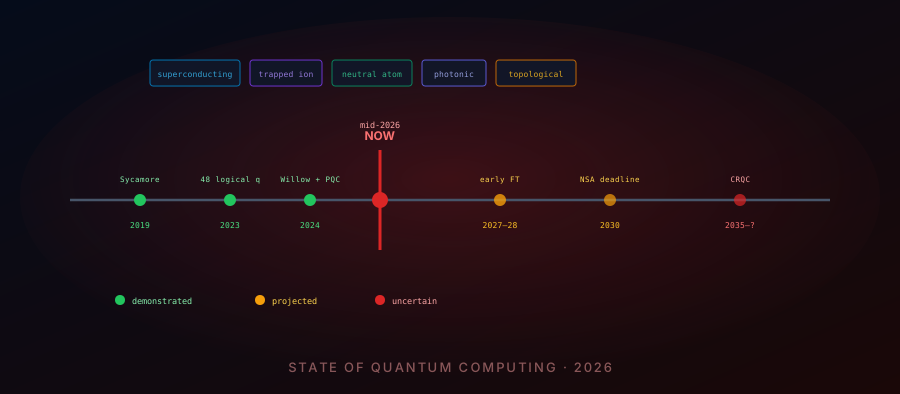
- State of Quantum Computing: Mid-2026 Edition
Five hardware platforms. Four NIST cryptographic standards. Two contested quantum advantage claims. One below-threshold error correction milestone. Seven years after the NISQ era began, quantum computing is at an inflection point. Here is a precise, unsentimental account of where every major platform stands, what has been proved, what remains unproven, and what the next decade realistically looks like.
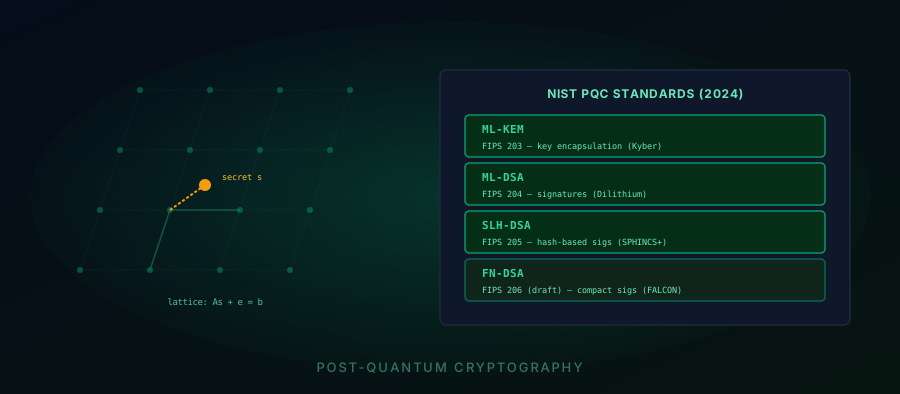
- Post-Quantum Cryptography: The Algorithms Replacing RSA Before the Quantum Computer Arrives
Every TLS connection, every signed certificate, every encrypted email uses cryptography that Shor's algorithm can break. NIST finalised four post-quantum cryptographic standards in 2024 — ML-KEM, ML-DSA, SLH-DSA, and FN-DSA — based on mathematical problems that quantum computers are not known to solve efficiently. Here is the threat model, the mathematics, the size trade-offs, and why migration is already urgent even though the quantum computer does not exist yet.
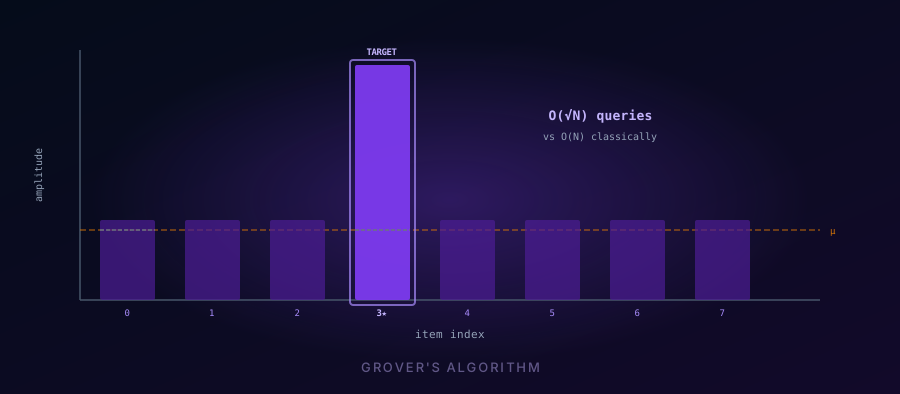
- Grover's Algorithm: The Quantum Speedup That Doesn't Break Everything — But Still Matters
Grover's algorithm searches an unstructured database of N items in O(√N) steps rather than O(N) classically — a quadratic speedup that is provably optimal for quantum computers. Unlike Shor's exponential advantage, the quadratic speedup can be countered by doubling key sizes. But understanding exactly why, and where Grover's algorithm actually applies, is essential for anyone reasoning about quantum cryptographic risk.
- The Algorithm That Broke RSA: Shor's Factoring Algorithm Explained
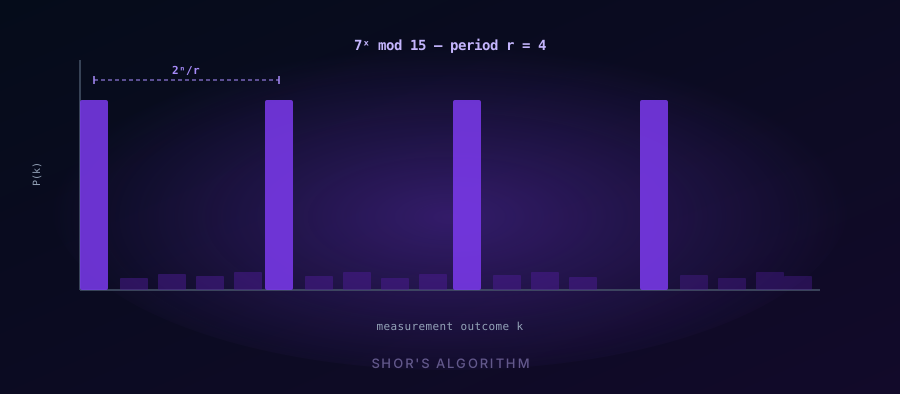
In 1994, Peter Shor proved that a quantum computer can factor large integers in polynomial time — rendering RSA, ECC, and Diffie-Hellman cryptography conditionally obsolete. Here is exactly how the algorithm works, why the Quantum Fourier Transform is the key, what hardware it would actually require, and what the world is doing about it.
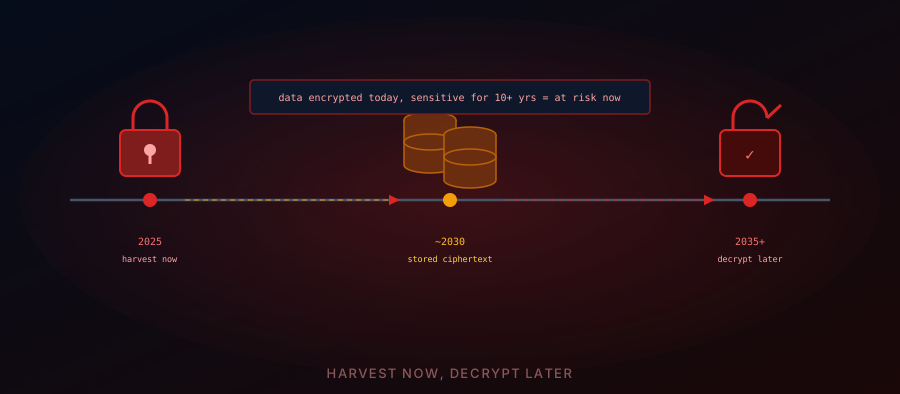
- Harvest Now, Decrypt Later: The Quantum Threat Reshaping Global Cryptography
Every encrypted message sent today could be stored by adversaries and decrypted once a sufficiently powerful quantum computer exists. The window to act is narrowing — here is what the world is doing about it.