Tag
#quantum cryptography
4 articles
- E91: The Protocol That Turns Bell's Theorem Into an Eavesdropping Detector
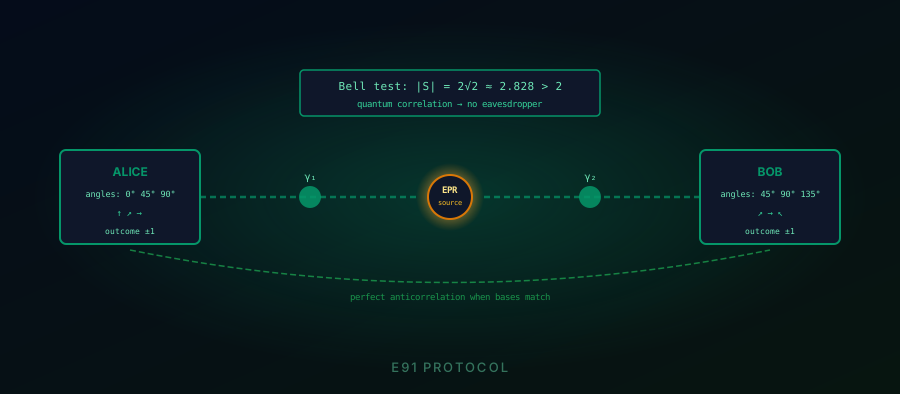
Where BB84 detects eavesdroppers by watching for measurement disturbances on individual photons, E91 — proposed by Artur Ekert in 1991 — detects them by testing whether quantum correlations between entangled photon pairs violate a Bell inequality. If they do, no eavesdropper could have intervened. Here is the physics, the mathematics of the CHSH test, and why E91's entanglement-based approach leads directly to device-independent quantum cryptography.
- Post-Quantum Cryptography: The Algorithms Replacing RSA Before the Quantum Computer Arrives
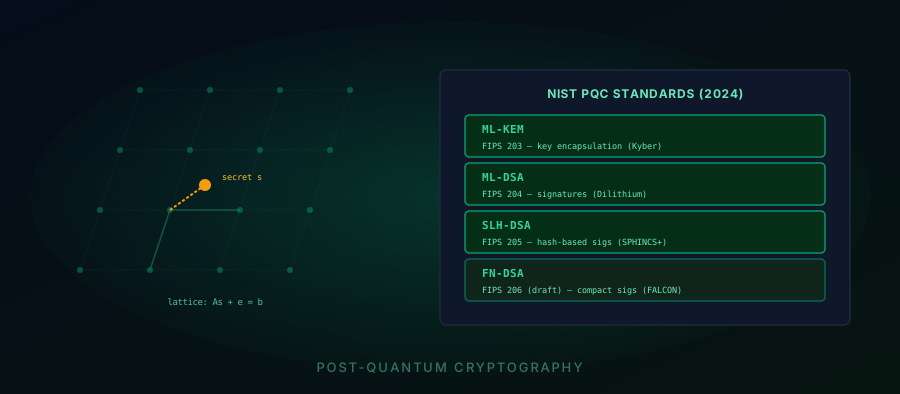
Every TLS connection, every signed certificate, every encrypted email uses cryptography that Shor's algorithm can break. NIST finalised four post-quantum cryptographic standards in 2024 — ML-KEM, ML-DSA, SLH-DSA, and FN-DSA — based on mathematical problems that quantum computers are not known to solve efficiently. Here is the threat model, the mathematics, the size trade-offs, and why migration is already urgent even though the quantum computer does not exist yet.
- The Algorithm That Broke RSA: Shor's Factoring Algorithm Explained
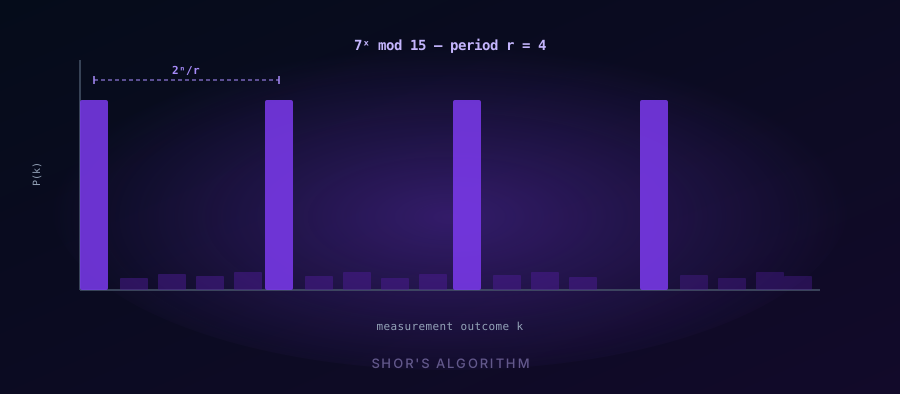
In 1994, Peter Shor proved that a quantum computer can factor large integers in polynomial time — rendering RSA, ECC, and Diffie-Hellman cryptography conditionally obsolete. Here is exactly how the algorithm works, why the Quantum Fourier Transform is the key, what hardware it would actually require, and what the world is doing about it.
- BB84: The Protocol That Made Eavesdropping a Physics Problem
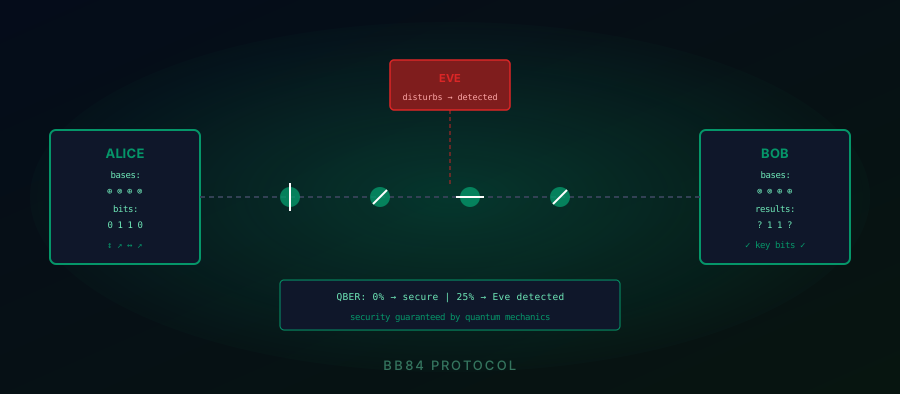
The BB84 protocol, proposed in 1984, showed for the first time that physical law — not computational hardness — could guarantee communication security. Here is exactly how it works, why an eavesdropper cannot hide, and what the real-world limitations are.