When researchers talk about quantum machine learning in concrete terms, they almost always mean parametrised quantum circuits (PQCs): shallow quantum circuits with tunable gate angles, optimised by a classical computer in a feedback loop. The structure is intuitive — encode data into quantum states, process it through trainable quantum operations, measure the output, compute a loss, update the parameters. The circuit is the model. The classical optimiser does the gradient descent.
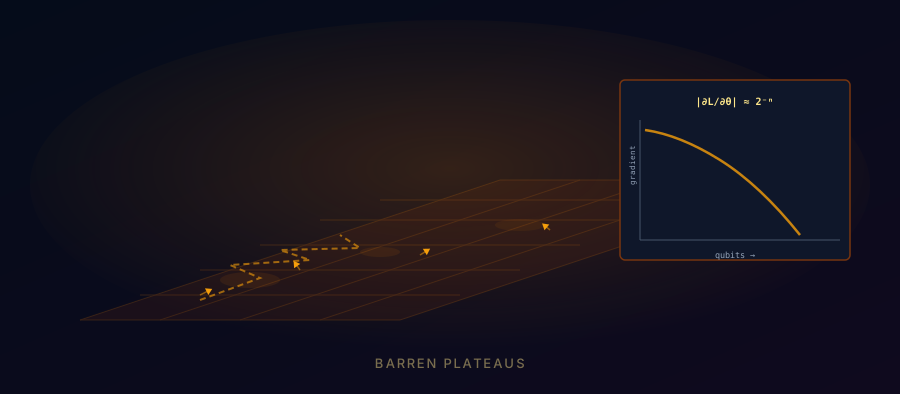
The problem is that as these circuits grow more powerful — more qubits, more layers, more parameters — the gradients that guide training do not merely shrink. They shrink exponentially. In a system of qubits, the gradient of a typical cost function scales as . At 50 qubits, the training landscape is so flat that no gradient signal is distinguishable from numerical noise. This is the barren plateau problem, and it is the most significant obstacle in quantum machine learning today — not a hardware limitation, but a mathematical one.
Where Parametrised Quantum Circuits Are Used
Classification
Quantum kernels and PQC classifiers for structured datasets where quantum feature maps may offer expressibility advantages.
Combinatorial Optimisation
QAOA — the Quantum Approximate Optimisation Algorithm — uses a fixed-structure PQC to find approximate solutions to NP-hard problems.
Quantum Chemistry
VQE uses problem-inspired PQCs to approximate ground-state energies of molecular Hamiltonians on near-term hardware.
Generative Modelling
Quantum GANs and quantum Boltzmann machines use PQCs to generate distributions that may be hard to sample from classically.
How Parametrised Quantum Circuits Work
A PQC is a layered structure. Classically, you can think of it as a neural network where the forward pass is quantum mechanical and the backward pass is classical. Each layer consists of parametrised single-qubit rotations interleaved with fixed entangling gates.
Training is performed using the parameter shift rule: to compute the gradient of the cost with respect to a parameter , the circuit is evaluated twice with shifted by , and the results subtracted. This gives the exact gradient, executable on real quantum hardware, without backpropagation through the circuit. For small circuits with a handful of qubits and shallow depth, this works well.
The Flatness That Swallowed the Field
In 2018, Jarrod McClean and colleagues at Google published the result that made the quantum ML community reassess its assumptions: for random quantum circuits, the variance of the cost function gradient decreases exponentially with the number of qubits.
Concretely: for a circuit with qubits, the variance of a gradient component scales as:
The consequence is severe. At 10 qubits, gradients are small but non-zero. At 20 qubits, they are roughly 1,000 times smaller. At 30 qubits, roughly a billion times smaller than at 10 qubits. The optimiser cannot distinguish a meaningful direction from numerical noise. Training stalls — not because the minimum does not exist, but because the landscape is exponentially flat everywhere except in an exponentially small region near the solution.
What Causes Barren Plateaus
Three factors determine how quickly a circuit enters a barren plateau regime.
Circuit expressibility. Circuits that can represent a large family of quantum states — a property called expressibility — are also the ones that flatten fastest. Highly expressible circuits explore more of Hilbert space, and in a high-dimensional space the average gradient is zero almost everywhere. There is a direct trade-off: the circuits most capable of representing complex quantum states are the hardest to train.
Global versus local cost functions. Cost functions that measure properties of all qubits simultaneously — global observables — suffer exponentially worse barren plateaus than those measuring individual qubits or small subsets. Replacing a global Hamiltonian with a sum of local terms does not change the minimum, but it dramatically changes the gradient landscape.
Entanglement dynamics. Circuits that generate high entanglement rapidly scramble information across all qubits — the same process that makes quantum computers hard to simulate classically. This scrambling also erases local gradient information, causing the plateau. The connection between barren plateaus and quantum information scrambling is now well established theoretically.
2018
Year barren plateaus were formally identified and named by McClean et al. at Google
O(1/2ⁿ)
Gradient variance scaling with n qubits in a random deep circuit — exponential suppression
~20
Qubits at which gradient-based training of random global-cost circuits becomes infeasible in practice
Strategies for Navigation
Barren plateaus do not make quantum ML impossible. They constrain which circuits and cost functions are trainable — and the research around this constraint has become one of the most active areas in quantum computing.
Mitigation Approaches
Optimise a few layers at a time, initialising each new block near the identity. Reduces effective circuit depth seen by the optimiser at any step.
Design circuit structure to reflect the problem's physics — QAOA for graphs, hardware-efficient ansatz for device topology. Fewer parameters, less flat landscape.
Replace global observables with sums of single-qubit or few-qubit terms. Gradient variance becomes polynomial rather than exponential in system size.
Preconditions gradients by the quantum Fisher information matrix — the Riemannian geometry of the quantum state manifold — finding better descent directions.
Initialise PQC parameters from a pre-trained model on a related task, avoiding the random-initialisation regime where barren plateaus dominate.
When Quantum ML Actually Works
The barren plateau story is not only about constraints. It has clarified where quantum ML has genuine potential — and the answer is more specific and more interesting than “everywhere classical ML works.”
Structured problems with physically motivated circuit designs avoid barren plateaus by construction. VQE’s chemistry-inspired ansatz and QAOA’s graph structure both exploit domain knowledge to keep circuits shallow and gradients non-vanishing. These are the near-term applications most likely to show practical value.
Quantum data — information that originates in a quantum system, such as the output of a quantum sensor or another quantum processor — encodes naturally and efficiently into PQCs. Quantum ML on quantum data sidesteps the need for classical encoding, which is often where quantum advantages are lost.
Kernel methods offer an alternative to variational training entirely. A quantum kernel — a function measuring inner products in the quantum feature space — is computed directly from the circuit’s output, with no optimisation required. There is no gradient descent and therefore no barren plateau. Google’s 2021 demonstration of quantum kernel classification on structured datasets represents one of the most empirically rigorous QML results to date.
Key Takeaways
- Barren plateaus are a mathematical consequence of expressibility — the more capable a random circuit is, the flatter its training landscape.
- Global cost functions suffer exponential gradient suppression; local cost functions reduce this to polynomial, making significantly deeper circuits trainable.
- Mitigation strategies — layerwise training, problem-inspired ansätze, local costs, quantum natural gradient — are not workarounds; they are principled solutions grounded in the geometry of quantum state space.
- The most viable near-term QML applications are structured: VQE for chemistry, QAOA for optimisation, quantum kernels for classification. Not general-purpose replacements for classical neural networks.
- Barren plateaus drove QML from broad claims toward precise, verifiable, domain-specific claims. That narrowing is a sign of scientific maturity, not retreat.
Barren plateaus were not the death of quantum machine learning. They were its adolescence. The field is now older and more honest: clearer about which circuits train, which problems benefit, and which comparisons with classical ML are fair. The researchers who took the barren plateau problem seriously — rather than dismissing it — built the foundations that will make quantum ML credible at scale.
That credibility, earned the hard way through mathematical rigour rather than benchmarking optimism, is ultimately what the field will need to deliver on its original promise.
Sources & Further Reading
- Barren Plateaus in Quantum Neural Network Training Landscapes. Nature Communications 9, 4812; arXiv:1803.11173 (2018)
- Cost Function Dependent Barren Plateaus in Shallow Parametrized Quantum Circuits. Nature Communications 12, 1791; arXiv:2001.00550 (2021)
- Connecting Ansatz Expressibility to Gradient Magnitudes and Barren Plateaus. PRX Quantum 3, 010313; arXiv:2101.02138 (2022)
Discussion