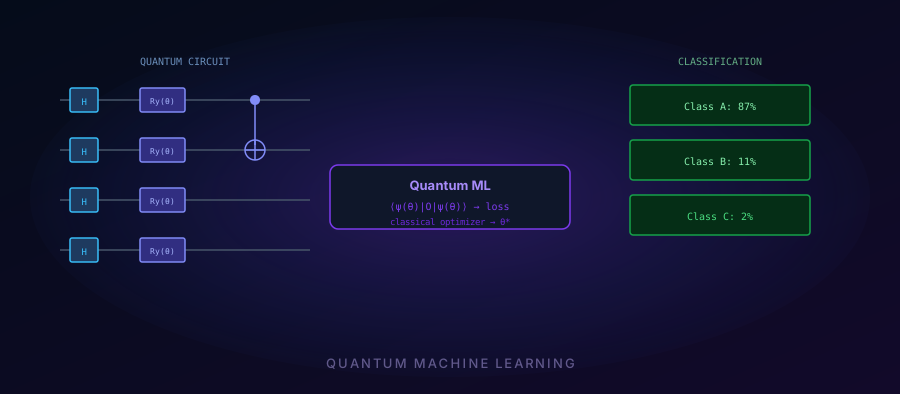
Machine learning has transformed how we process language, recognise images, and predict outcomes across medicine, finance, and science. But the classical hardware running these models — GPUs, TPUs, massive data centres — is approaching physical limits. Transistors can only shrink so far. The question the field is now seriously asking: what comes next?
One answer, still nascent but accelerating fast, is quantum machine learning (QML). It is not a replacement for classical deep learning. It is a new computational substrate — one that exploits the strange, counterintuitive behaviour of quantum mechanics to tackle problems that classical algorithms find intractable.
The Qubit Advantage
Classical computers store information as bits — binary switches that are either 0 or 1. A quantum computer uses qubits, which can exist in a superposition of both states simultaneously. This is not just an analogy; it is a precise mathematical statement about probability amplitudes.
When we apply this to machine learning, the implications scale exponentially. A system of just 50 qubits can represent 2⁵⁰ states simultaneously — more than a quadrillion — in a single quantum register. This gives quantum algorithms a structural advantage on certain high-dimensional problems, particularly optimisation and sampling, that lie at the heart of modern machine learning.
Variational Quantum Circuits: The Quantum Neural Network
The most promising near-term architecture in QML is the variational quantum circuit (VQC), sometimes called a parametrised quantum circuit. It is, in essence, the quantum analogue of a neural network layer.
A VQC encodes classical data as quantum states, applies a sequence of trainable quantum gates, then measures the output to extract a classical result. A classical optimiser then adjusts the gate parameters — exactly as gradient descent adjusts weights in a neural network.
The elegance of VQCs is that they run on today’s noisy hardware. Unlike the fault-tolerant algorithms of the far future, variational circuits are shallow and tolerant of modest error rates — making them the dominant QML architecture of the NISQ era.
The Hybrid Paradigm
Quantum ML will not replace classical ML. The realistic near-term picture is hybrid quantum-classical computing: quantum processors handle specific subtasks where they excel, while classical computers manage everything else.
Frameworks such as IBM’s Qiskit, Xanadu’s PennyLane, and Google’s Cirq already support this paradigm. Models run on real quantum hardware — IBM Eagle, Google Sycamore, IonQ Aria — and the feedback loop between classical optimiser and quantum circuit is measured in milliseconds.
Where Quantum ML Shows Early Promise
Three application domains show genuine near-term potential:
Molecular simulation and drug discovery. Quantum processors natively simulate quantum systems. Modelling a molecule’s electron configuration — a task that scales exponentially on classical hardware — is manageable on even modest quantum hardware. Quantinuum and IBM are running quantum-assisted screening pipelines today.
Combinatorial optimisation. Scheduling, logistics, and portfolio construction all require searching enormous solution spaces. Quantum algorithms such as QAOA (Quantum Approximate Optimization Algorithm) have demonstrated advantages over classical heuristics on structured instances of these problems.
Quantum kernel methods. Quantum kernels — functions measuring similarity between data points in exponentially large quantum feature spaces — may offer classification advantages on datasets with geometric structure that classical kernels cannot efficiently capture.
An Honest Timeline
2024–2027 (NISQ era): Noisy hardware with ~1,000 physical qubits and no full error correction. Hybrid algorithms run on real devices but do not yet demonstrate broad practical advantage over classical methods. The work is proofs-of-concept, narrow benchmarks, and domain-specific pilots.
2027–2032 (early fault-tolerant): As logical qubit counts grow through improved error correction, reliable quantum advantage will emerge in specific domains — molecular simulation and financial optimisation being the most likely candidates.
2032+ (mature quantum era): Large-scale fault-tolerant machines capable of running algorithms like Shor’s and Grover’s at commercial scale. At this horizon, QML models could transform drug design, materials discovery, and cryptographic security in fundamental ways.
The Convergence
The future of machine learning is not classical or quantum. It is a spectrum — computation routed to the right substrate for each task. Understanding QML now is not about predicting when quantum chips replace GPUs. It is about recognising the inflection points — narrow problems, specific dataset geometries, particular optimisation structures — where quantum processing will first deliver measurable, reproducible advantage.
Those inflection points are closer than most headlines acknowledge, and further than most press releases claim. The researchers building toward them are doing some of the most important applied science of the decade.
Sources & Further Reading
- Quantum Machine Learning. Nature 549, 195; arXiv:1611.09347 (2017)
- An Introduction to Quantum Machine Learning. Contemporary Physics 56(2); arXiv:1409.3097 (2015)
- Variational Quantum Algorithms. Nature Reviews Physics 3, 625; arXiv:2012.09265 (2021)
Discussion