Tag
#quantum advantage
3 articles
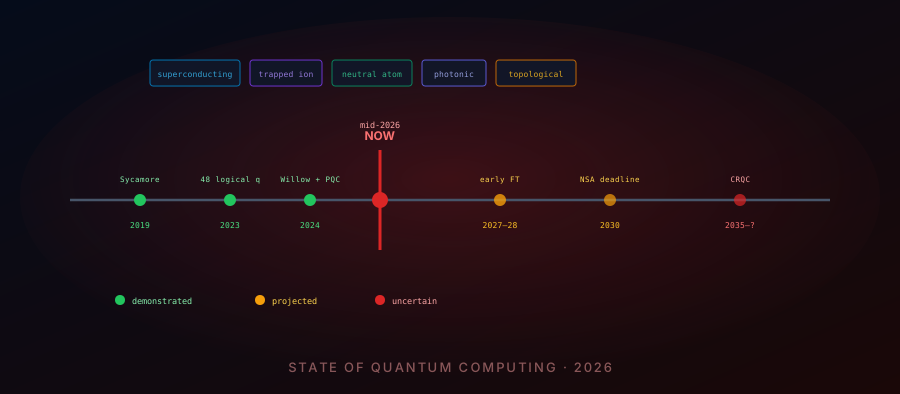
- State of Quantum Computing: Mid-2026 Edition
Five hardware platforms. Four NIST cryptographic standards. Two contested quantum advantage claims. One below-threshold error correction milestone. Seven years after the NISQ era began, quantum computing is at an inflection point. Here is a precise, unsentimental account of where every major platform stands, what has been proved, what remains unproven, and what the next decade realistically looks like.
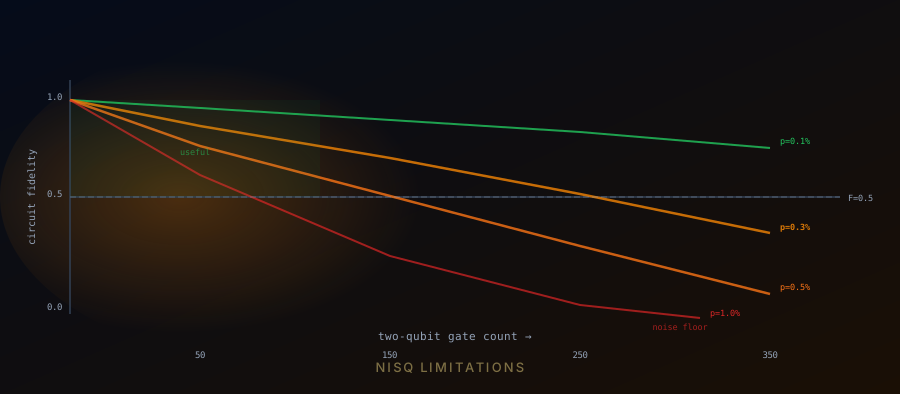
- The Honest State of NISQ: What Noisy Intermediate-Scale Quantum Computers Can and Cannot Do
John Preskill coined 'NISQ' in 2018 to describe the quantum processors of the near-term era — 50 to 1000 noisy qubits, too small for error correction, too large to fully simulate classically. Seven years later, the honest accounting is clearer: NISQ has produced important scientific insights and genuine hardware progress, but no quantum advantage on a practically useful problem. Here is exactly why, and what the path forward looks like.
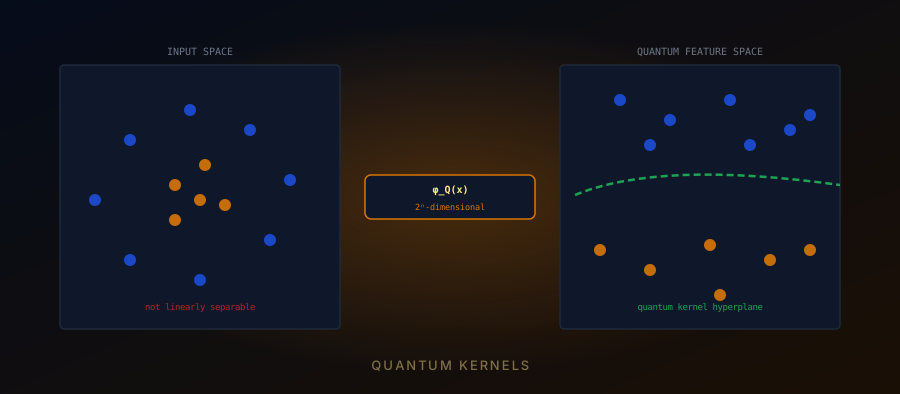
- Quantum Kernels and QSVMs: Can Quantum Feature Spaces Give Machine Learning an Edge?
Support vector machines classify data by finding a separating hyperplane in a high-dimensional feature space, using the kernel trick to avoid computing the feature map explicitly. Quantum computers can evaluate inner products in exponentially large Hilbert spaces — making quantum kernels a natural candidate for quantum advantage in machine learning. Here is how quantum kernel SVMs work, what has been proved about their advantage, and where the honest limits currently lie.