All Articles
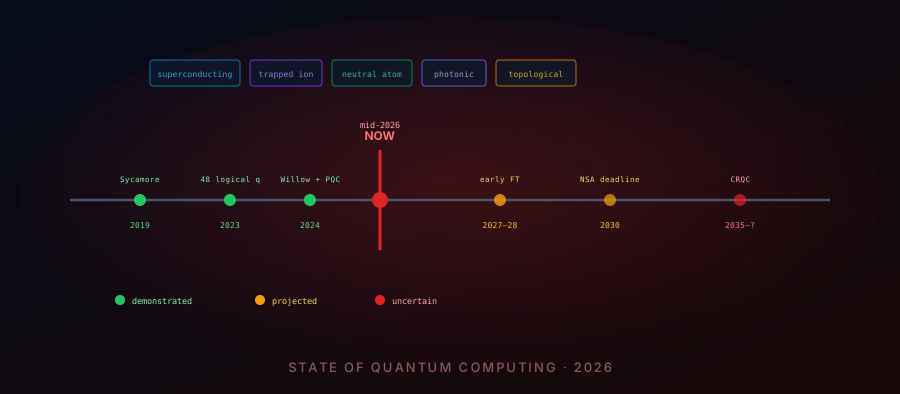
Five hardware platforms. Four NIST cryptographic standards. Two contested quantum advantage claims. One below-threshold error correction milestone. Seven years after the NISQ era began, quantum computing is at an inflection point. Here is a precise, unsentimental account of where every major platform stands, what has been proved, what remains unproven, and what the next decade realistically looks like.
- The Honest State of NISQ: What Noisy Intermediate-Scale Quantum Computers Can and Cannot Do
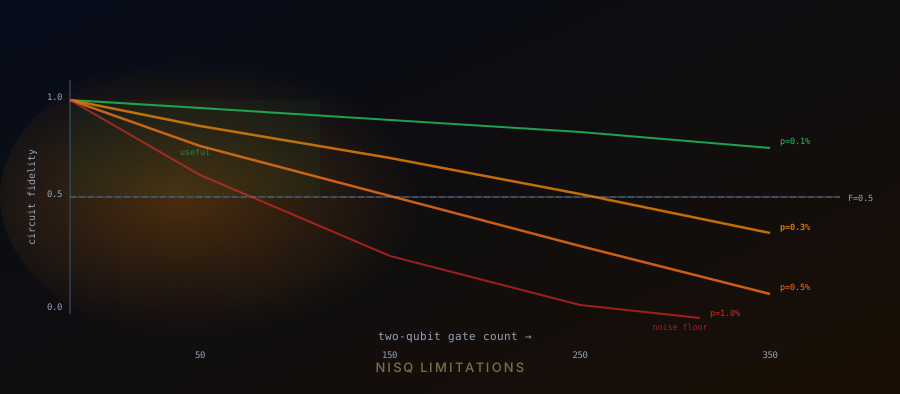
John Preskill coined 'NISQ' in 2018 to describe the quantum processors of the near-term era — 50 to 1000 noisy qubits, too small for error correction, too large to fully simulate classically. Seven years later, the honest accounting is clearer: NISQ has produced important scientific insights and genuine hardware progress, but no quantum advantage on a practically useful problem. Here is exactly why, and what the path forward looks like.
- Quantum Kernels and QSVMs: Can Quantum Feature Spaces Give Machine Learning an Edge?
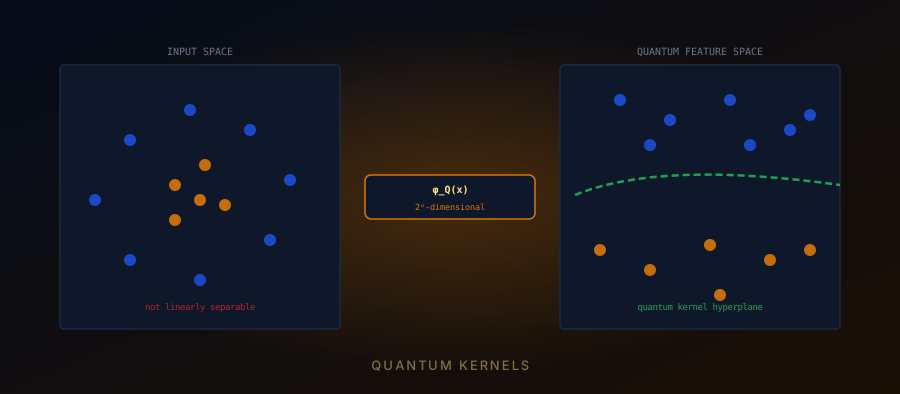
Support vector machines classify data by finding a separating hyperplane in a high-dimensional feature space, using the kernel trick to avoid computing the feature map explicitly. Quantum computers can evaluate inner products in exponentially large Hilbert spaces — making quantum kernels a natural candidate for quantum advantage in machine learning. Here is how quantum kernel SVMs work, what has been proved about their advantage, and where the honest limits currently lie.
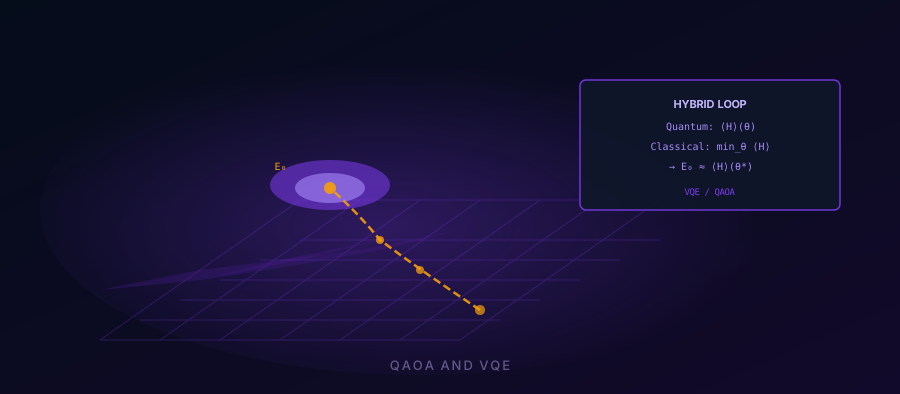
- QAOA and VQE: The Variational Algorithms That Define the NISQ Era
Before fault-tolerant quantum computers arrive, the algorithms most likely to demonstrate practical quantum advantage are variational: hybrid quantum-classical loops where a shallow quantum circuit estimates an objective function and a classical optimizer tunes the circuit parameters. VQE targets quantum chemistry; QAOA targets combinatorial optimization. Here is how both work, what they have achieved, and where the honest limits of the approach currently lie.
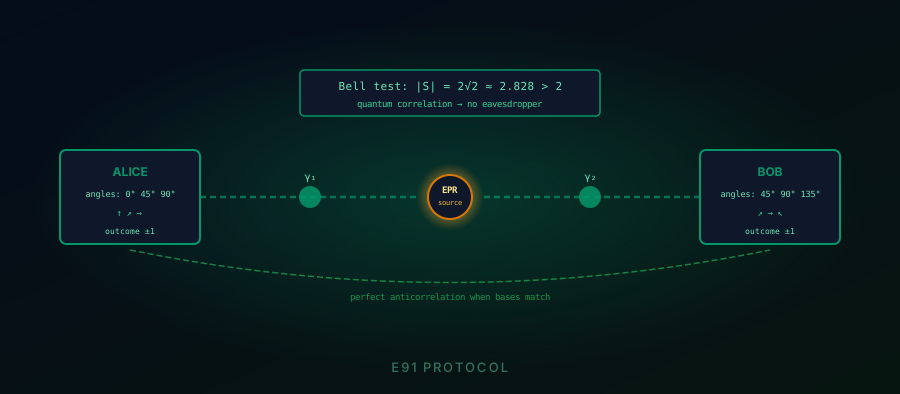
- E91: The Protocol That Turns Bell's Theorem Into an Eavesdropping Detector
Where BB84 detects eavesdroppers by watching for measurement disturbances on individual photons, E91 — proposed by Artur Ekert in 1991 — detects them by testing whether quantum correlations between entangled photon pairs violate a Bell inequality. If they do, no eavesdropper could have intervened. Here is the physics, the mathematics of the CHSH test, and why E91's entanglement-based approach leads directly to device-independent quantum cryptography.
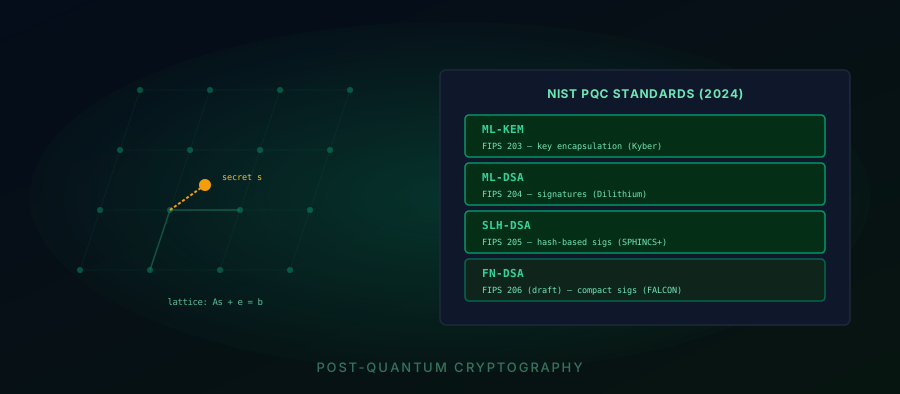
- Post-Quantum Cryptography: The Algorithms Replacing RSA Before the Quantum Computer Arrives
Every TLS connection, every signed certificate, every encrypted email uses cryptography that Shor's algorithm can break. NIST finalised four post-quantum cryptographic standards in 2024 — ML-KEM, ML-DSA, SLH-DSA, and FN-DSA — based on mathematical problems that quantum computers are not known to solve efficiently. Here is the threat model, the mathematics, the size trade-offs, and why migration is already urgent even though the quantum computer does not exist yet.
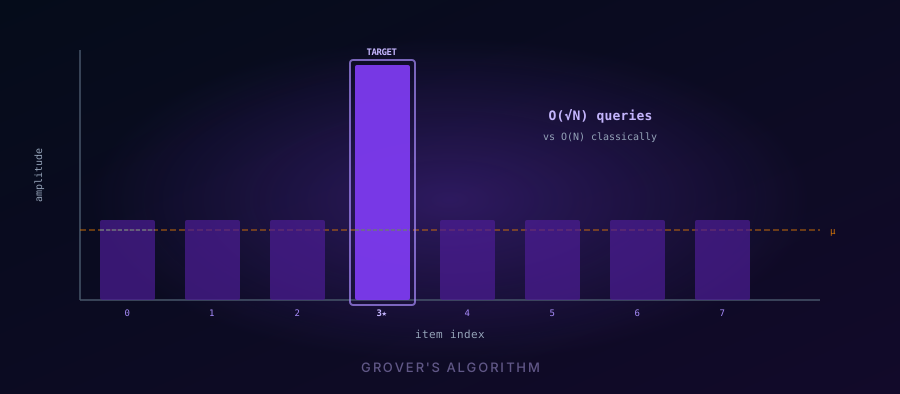
- Grover's Algorithm: The Quantum Speedup That Doesn't Break Everything — But Still Matters
Grover's algorithm searches an unstructured database of N items in O(√N) steps rather than O(N) classically — a quadratic speedup that is provably optimal for quantum computers. Unlike Shor's exponential advantage, the quadratic speedup can be countered by doubling key sizes. But understanding exactly why, and where Grover's algorithm actually applies, is essential for anyone reasoning about quantum cryptographic risk.
- The Algorithm That Broke RSA: Shor's Factoring Algorithm Explained
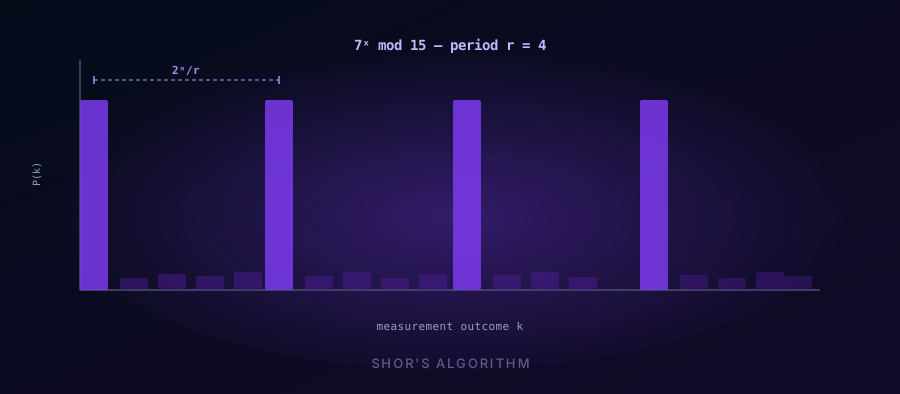
In 1994, Peter Shor proved that a quantum computer can factor large integers in polynomial time — rendering RSA, ECC, and Diffie-Hellman cryptography conditionally obsolete. Here is exactly how the algorithm works, why the Quantum Fourier Transform is the key, what hardware it would actually require, and what the world is doing about it.
- The Topological Bet: How Microsoft Is Building Qubits That Are Physically Immune to Errors
Every other qubit platform corrects errors in software, paying a price of hundreds of physical qubits per logical qubit. Microsoft's topological qubit encodes information in the non-local parity of Majorana zero modes — a quantum property that local noise physically cannot disturb. Here is the physics, the hardware, the controversy, and where the approach stands after the February 2025 Nature paper.

- Fixing Broken Qubits: How the Surface Code Makes Fault-Tolerant Quantum Computing Possible
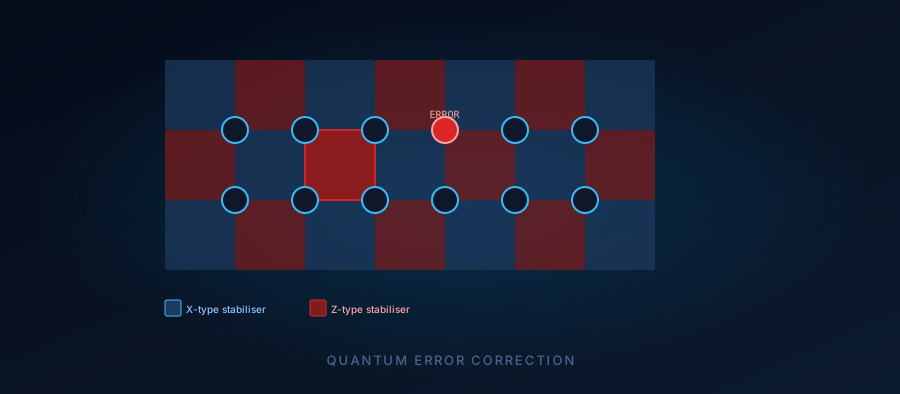
Every qubit in a quantum processor makes mistakes — not sometimes, but continuously. Quantum error correction doesn't prevent errors; it encodes logical qubits redundantly across many physical ones so that errors can be detected and corrected without ever directly measuring the quantum state. Here is how the surface code achieves this, what the overhead actually costs, and why Google's 2023 demonstration changed the field.
- Light as a Qubit: The Physics and Promise of Photonic Quantum Computing
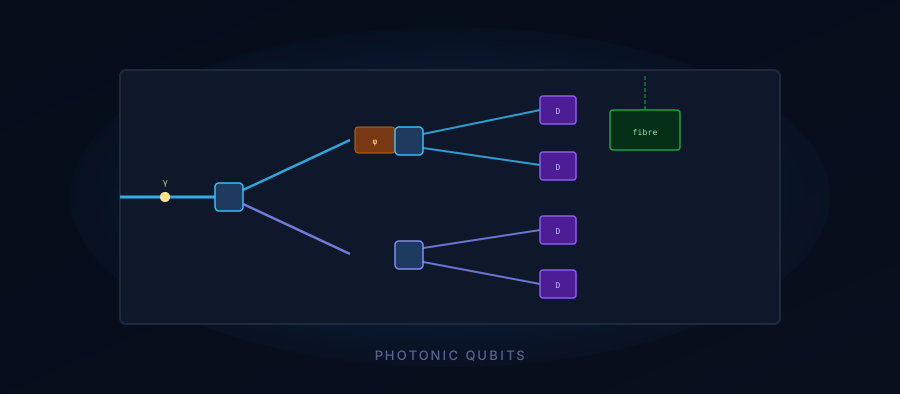
Photons are the only qubits that can travel through optical fibre, operate at room temperature without any cryogenics, and be manufactured on silicon chips in commercial CMOS fabs. The catch: photons don't interact with each other. Here is how the field is engineering around that fundamental constraint.
- Atoms in a Grid: How Neutral Atom Quantum Computers Are Quietly Redefining Scale
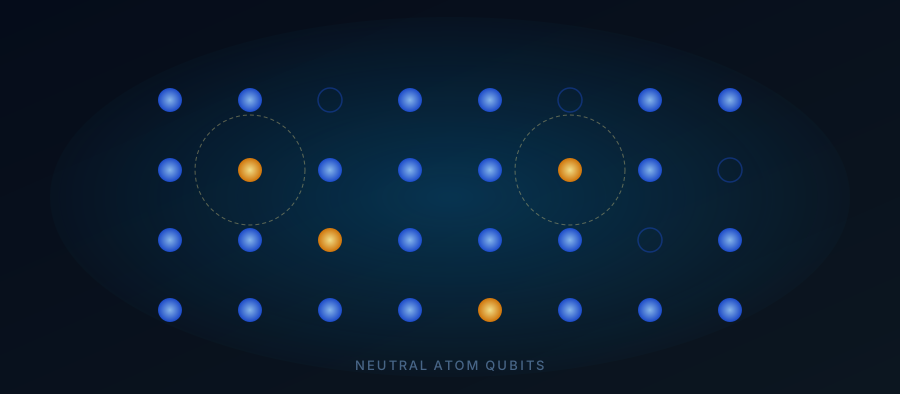
Neutral atom quantum computers trap individual atoms with laser light, arrange them in arbitrary 2D patterns, and entangle them through a quantum mechanical phenomenon called the Rydberg blockade. QuEra recently demonstrated 48 logical qubits — the most ever achieved on any hardware platform. Here is exactly how the platform works.
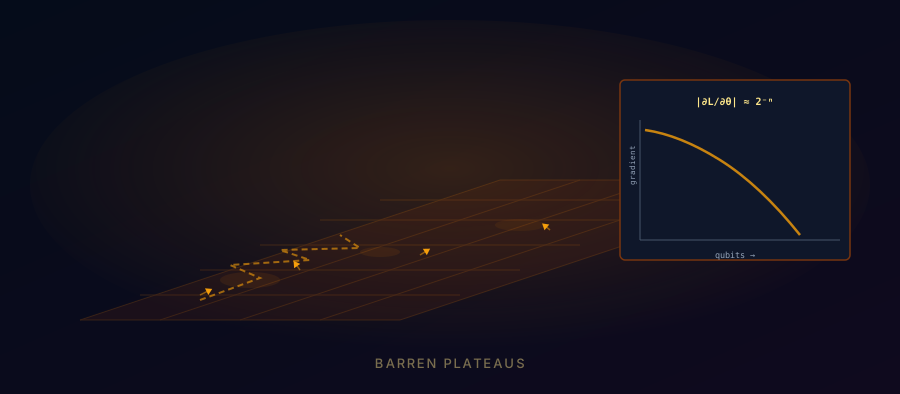
- Vanishing Gradients at Quantum Scale: The Barren Plateau Problem in Quantum ML
Parametrised quantum circuits are the foundation of quantum machine learning — but a fundamental obstacle called the barren plateau causes gradients to vanish exponentially as circuits grow. Here is what causes it, why it almost derailed the field, and the strategies now being used to navigate around it.
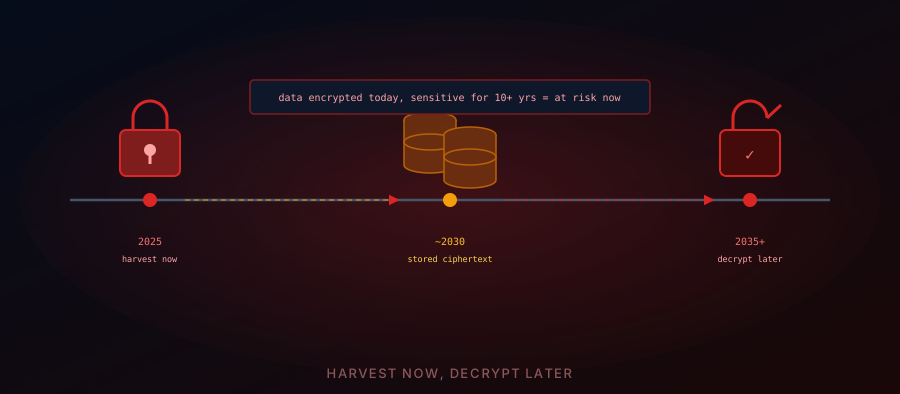
- Harvest Now, Decrypt Later: The Quantum Threat Reshaping Global Cryptography
Every encrypted message sent today could be stored by adversaries and decrypted once a sufficiently powerful quantum computer exists. The window to act is narrowing — here is what the world is doing about it.
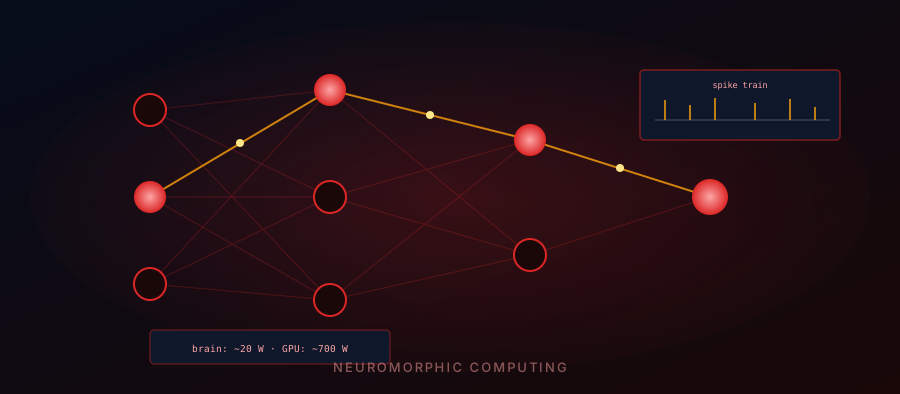
- Beyond the GPU: How Neuromorphic Chips Are Rewriting the Rules of AI Hardware
GPUs power the AI revolution — but they were never designed for it. Neuromorphic chips, built to mimic the brain's own architecture, offer a fundamentally different path to efficient, real-time intelligence.
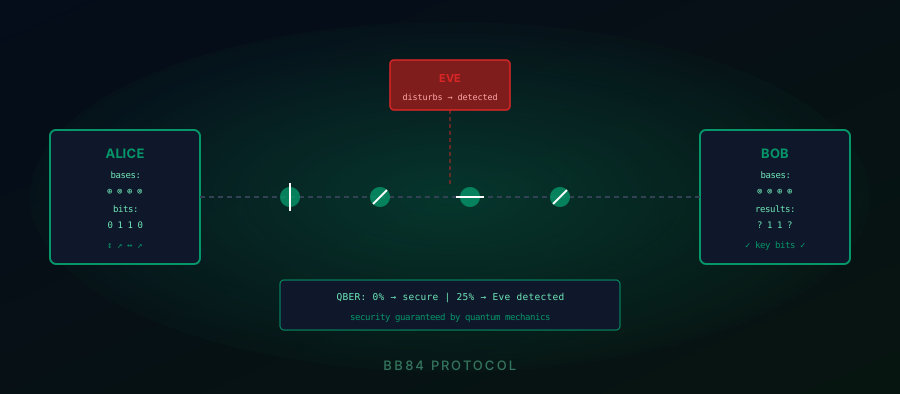
- BB84: The Protocol That Made Eavesdropping a Physics Problem
The BB84 protocol, proposed in 1984, showed for the first time that physical law — not computational hardness — could guarantee communication security. Here is exactly how it works, why an eavesdropper cannot hide, and what the real-world limitations are.
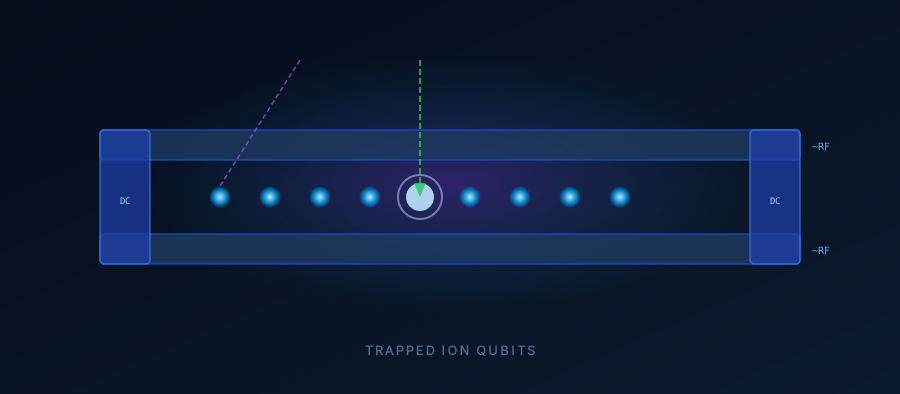
- Trapped Ions: The Most Precise Qubits on Earth — and Why Scaling Them Is So Hard
Trapped ion quantum computers hold coherence for minutes where superconducting chips manage microseconds, and entangle any two qubits with 99.9% fidelity. Here is the physics of how they work — and the engineering challenge that stands between them and scale.
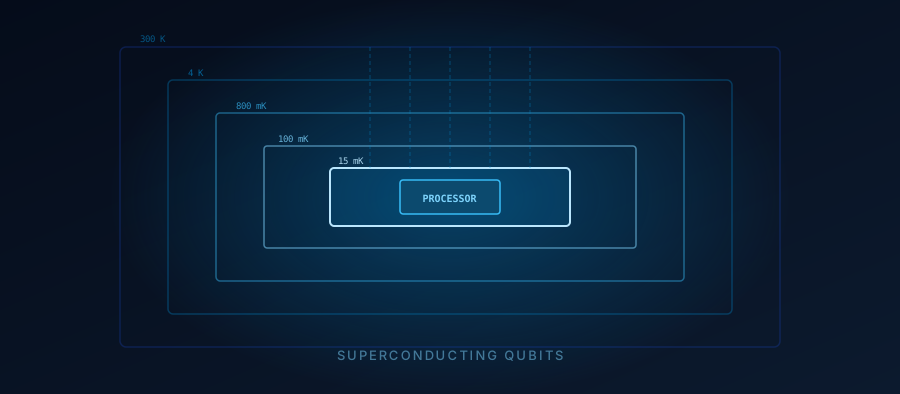
- Inside the Dilution Refrigerator: The Extreme Engineering of Superconducting Qubits
Every superconducting quantum processor requires a machine the size of a chandelier, operating 150 times colder than deep space, threaded with hundreds of precision microwave cables. Here is what is actually happening inside.
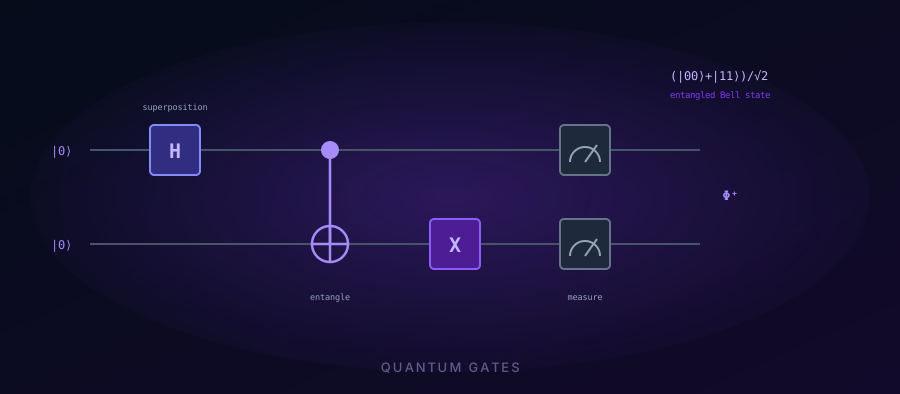
- Quantum Gates Explained: The Logic Behind Quantum Circuits
A practical deep-dive into quantum gates — the Hadamard, Pauli, and CNOT operations — and how combining just two of them creates entanglement, the most powerful resource in quantum computing.
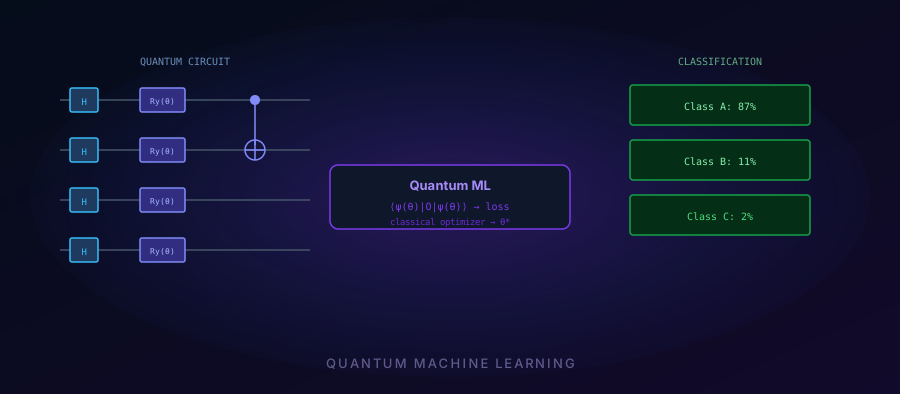
- The Future of Quantum Machine Learning
An introductory overview of how quantum computing accelerates AI — from qubits and variational circuits to real-world applications and an honest timeline.
- When AI Becomes the Scientist: How Machine Learning Is Accelerating Discovery
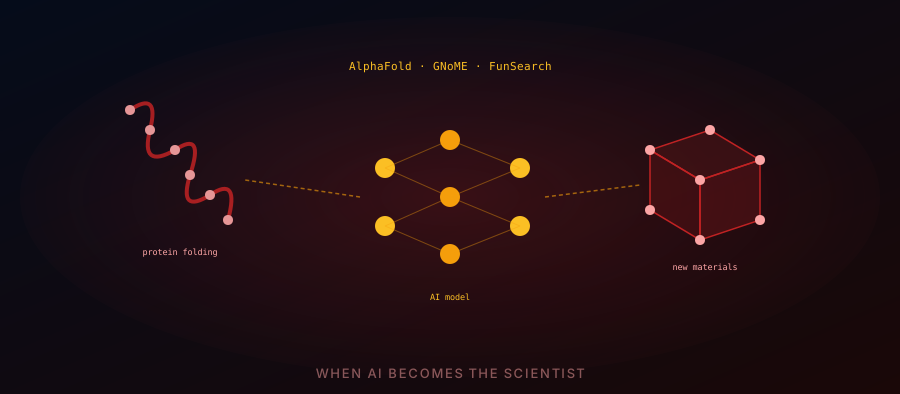
AlphaFold solved protein folding in months. GNoME predicted 2.2 million new crystal structures. FunSearch found new algorithms in mathematics. Across discipline after discipline, AI is compressing decades of research into years — and raising urgent questions about what it means to do science.
- The Quantum Internet: How Entanglement Will Rewire Global Communication
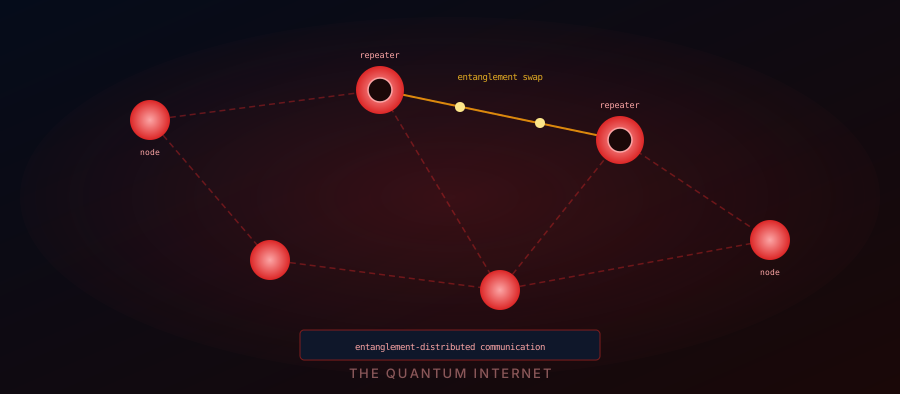
The quantum internet is not a faster version of the internet we have. It is a parallel communication layer built on entanglement — and it will enable capabilities that classical physics makes impossible.